Saturday, September 30, 2006

A Couple of Train Sightings

While on my bike ride in Chatfield State Park today, I rode the length of the dam. As I began my traversal of the dam, I saw a stopped northbound empty coal train and wondered if it would block my route at the other end of the dam. As I rode on, the train began to move. However, there was another train right behind it and not all that far behind it. I always thought it was unusual to see two trains on the same track so close together. The first northbound train was another of the many BNSF coal trains that utilize the Joint Line. The train behind it turned out to be rather unusual. It was just 7 engines – five SD70MACs and a couple of AC4400CWs.

While all this was going by, a loaded southbound coal train came along on the other track. It consisted mostly of brand new CEFX coal hoppers. The build dates on them were 09-2006. Here is a picture of one.


One of the trailing locomotives was a fairly new SD70Ace:


I really like this picture showing most of the train.


All these photos were taken at the southernmost end of the Chatfield dam.

Monday, September 25, 2006

Moffat Tunnel Area – 9/24/2006

My wife and I spent a good part of the afternoon exploring some semi-back roads up in the mountains looking for some fall colors including the road to the Moffat Tunnel. We found some good colors and even saw a train exit the tunnel. Right after it completed its emergence, the big ventilation system came on to eliminate the fumes from the tunnel. The fumes from one train can be considerable.


The fans are really noisy and when they start; they sound like a jet airplane starting its engines. They run for about 20 minutes and then shutoff. They railroad dispatcher does not let another train through the tunnel until the ventilation is complete.

We had in mind the possibility of doing a little hike up the trail that goes behind the tunnel but it was way too snowy and muddy for that. However, I did go up the trail a little ways to one of the many "restrooms" that are available. Here I am returning.


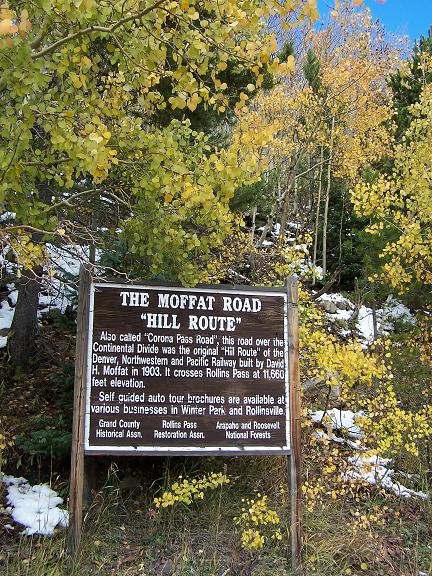
One of the interesting things about this area is the old railroad route over Rollins Pass, also known as Corona Pass. This sign is at the beginning of this road.


And this is what the road looks like. We didn’t go up this time but I have been up there on my bicycle.

Friday, September 22, 2006

The Texas Zephyr

The Texas Zephyr was a train that ran between Denver, Colorado and Fort Worth, Texas. I have driven between these two cities a number of times and to me, being a railfan, I enjoy the fact that US 287 follows the BNSF line much of the way. I wish I could take the train, though. This is a route not included on Amtrak's map. Before being part of the Burlington Northern and Santa Fe, the line was part of Burlington Northern. Before that, it was two different but related railroads. The Fort Worth and Denver and the Colorado and Southern Railways came together at Texline, Texas which is right on the New Mexico border in far northwestern Texas. The town was started by the FW&D railway and today is the home to about 500 residents. From Texline to Fort Worth, it was the FW&D. From Texline to Denver, it was the C&S except for the part where it shared the tracks with the Santa Fe and Rio Grande railroads.

The route was the home to an overnight passenger train called the Texas Zephyr. In 1950, it left Denver at 12:30 pm and arrived in Fort Worth at 6 am the next morning. Coming back, it left Fort Worth at 3 pm and arrived in Denver at 7:30 the next morning.

Equipment was the following for these daily trains:
4000 HP diesel locomotive (2 E5’s, I believe)
Reclining-seat chair cars
Dining-lounge
Special streamline Pullmans with drawing rooms, compartments, bedrooms, and sections.
All equipment was air-conditioned
No Extra Fare

Friday, September 15, 2006

When I Was Workin’ On the Railroad – Part VI, Leaving

It had always been my intention to return to college to earn a master’s degree. I had in mind an MBA and I ended up attending the University of Wisconsin starting in February, 1982. This was good plan, I thought, because the degree could be achieved in one calendar year since I had already earned a BBA at the University of Michigan.

In January of 1982, I reluctantly gave my notice and then my C&NW career came to an end after two fun years. You know, not everyone can say that their job is fun. I have had a number of software jobs since then and I would not call all of them fun.

While at the University of Wisconsin, I participated in the business school’s on-campus interviews. During this same time, I contacted the C&NW again to inquire about the possibility of returning. I was turned down but not because of my qualifications. Sadly, they had a hiring freeze on at the time so it was not to be. Happily, however, I did get a good job through an on campus interview with Texas Instruments and that began a significant turning point in my career and life. But that’s another story.

Skipping ahead to about 2002, I mentioned to an acquaintance in Colorado where I now live that I had once worked for a railroad in Chicago that didn’t exist anymore because it had become part of the Union Pacific. He said that he had a good friend who worked for the UP in Omaha who had once worked for the C&NW in Chicago. I immediately thought, “How many times had I heard this sort of thing?” He told me the fellow’s name and sure enough, it was someone I had known when I had worked there. In fact, it was the same person I had ridden with in the freight train that I wrote about in my previous post!

I ended up contacting Dean via email and we shared a few memories about people we had worked with way back when. Dean still worked for UP and I suppose he still does though I have lost contact with him once again and do not really know.

Tuesday, September 12, 2006

When I Was Workin’ On the Railroad – Part V, The Ride to Clinton

During my time working on the Locomotive Utilization System at the C&NW, the business analyst that we were working with found out that some of us had not had the opportunity to "go out on the road". He arranged for my partner and me to ride on a freight train from Proviso out to Clinton and back. This was a ride in the lead or second locomotive for about 120 miles one way.

We met the train at about 5:30 that morning at the west end of Proviso. The train was just about ready to go when we arrived. My partner, Dean and I were to trade between the lead locomotive and the second locomotive which was facing backwards. If I remember correctly the lead loco was a C&NW SD40-2 and the second one was a Union Pacific SD40-2 with a long "snoot" nose.

The ride out was the most eventful and I remember the most about it. Dean and I traded between the locos while the train was still moving although relatively slowly. We had been notified of a derailment that occurred the day before somewhere along the mainline. At some point we moved as fast as 79 mph (which was 4 over the limit). The derailment had been cleaned up but the site was obvious and we had to go through that stretch fairly slowly.

At one point we had a very interesting experience. We were approaching an intersection with a road at perhaps 50 mph. We were on the left hand track of two tracks. On the right hand track was a stopped freight train facing the same direction as our train. It was stopped for a signal short of the road crossing. Also on that same track was another freight train facing the opposite direction. It was stopped for a signal short of the road crossing on the other side. The two stopped trains were facing each other with the road crossing between them. We were moving along on the empty track. There were crossovers that one of the two stopped trains would use to cross over to the other track after we went by.

The interesting part of this passage was the behavior of the people in a car at the crossing as well as that of the experienced train crew. A man and a woman were in a station wagon and had approached the crossing. The gates were not yet down for our approach. The man driving the car slowed down to observe the two stopped trains to make sure they were not moving. He didn't initially spot us coming. When the gate came down for our approach, it came right down on the hood of the station wagon! The engineer saw this and pulled the horn and then hit the floor of the locomotive. So does the head end brakeman.

I was sitting in the left hand seat at the front of the locomotive (engineer on the right, brakeman behind) and I saw the crew hit the deck but I just sat there and I saw what the people in the car did. The woman in the passenger seat got out of the car and started running down the road away from the tracks. Then the man was able to back the car out of harms way. Then we went by the crossing and that was it. No accident.

The engineer thought I was dumb to not have hit the deck along with him. He said that you never know what part of a car might fly up right into the cab – maybe the hood of the car. I told him that I saw that the car driver was obviously going to get out of the way and therefore did not see the need to do anything.

The other thing that stands out about this trip was just how noisy it was in the cab. I don’t think they are quite as noisy these days but there was quite a racket in this loco. Besides the engine itself, there was the radio, hissing brakes, warning bells, horn, and the loud talking engineer who never stopped talking.

While we were in Clinton, Iowa, we met with some people and for the most part, hung around for a while not doing much. I remember that our host spotted what he thought was a problem with one of the cars on a coal train that was slowly passing by. He thought it was "off center". Freight cars are not attached to their trucks. They just have a pin that sits in a hole in the top of the truck – not unlike model train cars except unlike models, there is no screw attaching the car to the truck. If a car is off center, the pin has come out of its hole but is otherwise still sitting on the truck. The next event would be a derailment. He immediately entered one of the buildings to notify someone and he got the train to stop very quickly. Fortunately, it turned out to be a false alarm.

I don’t recall what was on the train going out to Clinton but I believe we caught one of the Falcons going back. The Falcon trains were the hotshot intermodal trains that the C&NW ran to and from the UP in Nebraska. Its destination was Wood Street in Chicago. This was a fast train as well and it doesn't usually stop at Proviso where our cars were parked. It didn't quite stop for us either but it did slow down to about 10 mph for us to hop off at the nearby Berkeley commuter station stop. It was a short walk through the weeds to get back into Proviso where our cars were parked.

The whole day took about 12 hours.

Saturday, September 09, 2006

When I Was Workin’ On the Railroad – Part IV, Locomotive Utilization

The most interesting computer system I worked on at the C&NW was the Locomotive Utilization (LU) System. Unfortunately for me, I never saw it to its completion because I left the company to return to school full time to earn a Master’s Degree.

I was one of the key designers and implementers. The railroad was very interested in maximizing the usage of their locomotives. Given the expense of these assets, it was foolish and expensive for the railroad to have idle locomotives. This would even lead to the purchase of more locomotives and such purchases add up very quickly considering that they cost around a million bucks even back in 1981.

The LU System had built into it a roster of the C&NW locomotives as well as locomotives from other railroads that might run on C&NW rails – such as those of the Union Pacific Railroad. The system also knew of all of the locations on every bit of the railroad along with mileage from certain other locations. Users of this system would enter in information about what locos were on what trains and when they went by these various locations. They could use this system to help maximize the locos usage. It also kept track of maintenance requirements so that they could make sure locos got to their maintenance points on time.

For locos of other railroads, the system kept track of horsepower miles and horsepower hours. If a 3000 horsepower locomotive went one mile, that was 3000 horsepower miles and if a 3000 horsepower locomotive spent an hour on the C&NW, that was 3000 horsepower hours. It was these measurements that were used by the railroads to repay each other for pooled locomotives. Every time a UP loco spent time and miles on the C&NW, a similar C&NW loco was supposed to spend the same amount of time and miles on the UP. If an imbalance occurred, one railroad would have to pay the other in cash.

About 20 years later, in about the year 2001, I met a fellow who learned of my interest in railroads. He told me that he knew someone who worked for the Union Pacific Railroad in Omaha. I told him that I worked for the C&NW back in 1980 and 1981. He said that his friend had worked for the C&NW also during that timeframe. It turns out that I actually worked with this person in Chicago. I thought the odds were against that.

I contacted him via email and he informed me among other things that the LU system had worked very well in its day. It’s long gone now as is the C&NW as an independent railroad. It’s part of Union Pacific and there is no doubt a new generation of computer system for the tracking and utilization of locomotives.

Thursday, September 07, 2006

When I Was Workin’ On the Railroad – Part III, Warehousing and Intemodal

My first assignment with the C&NW was to be part of a team that developed software for a warehouse inventory system. The railroad had a number of warehouses scattered about the country that stored equipment and materials for maintaining the railroad itself. Think hardware like spikes, rail, sledge hammers, as well as many more items for doing railroad business. This was a great way to get my feet wet with COBOL and Assembly language programming. And this was the first of a series of systems based on this same software architecture.

The second such system that I worked on was a system that kept track of trailers and containers as they arrived and departed from C&NW’s Wood Street intermodal yard (later known as Global I). Every time a truck with a trailer or container entered or exited the yard via railroad or concrete, an entry was made in this system by a clerk. Customers were charged for the time the railroad owned trailers and containers were in use off the railroad premises. So the system kept track of the time.

One of the problems with this system was that there was a significant number of errors in the manual data entry process. Numbers were transposed, for instance. This would result in trailers appearing to leave the yard and never return.

I remember when we first installed the intermodal system in 1980, we had to be at the yard where it was used around the clock. Members of the development team worked in shifts. I had the midnight to 8 am shift. It was a smooth installation so we didn’t have to keep this up very long.

Both of these systems were fun to develop and got my software career off to a great start.

Wednesday, September 06, 2006

When I Was Workin’ On the Railroad – Part II, Location

When I started working for the C&NW, I worked in the Riverside Plaza Building in downtown Chicago. This was the 400 West Madison Street headquarters address for the C&NW. In the next block west was the C&NW Terminal with an address of 500 West Madison.

The Riverside Plaza Building was completed in 1929 as the Chicago Daily News Building. The newspaper moved to another location sometime in the 60’s or 70’s. This building was the first commercial building erected on air rights over the railroad tracks that led to Union Station from the north. One of the interesting things about this building is that it included a system to carry smoke from steam engines up through the roof.

The building is 26 stories and I worked on the 4th or 5th floor. I remember that they had piped in music playing all day. It got more lively after lunch to help keep people who had large lunches alert and active. Here is a link to information about the building.

Another interesting thing about this building was the mural painted on the ceiling in one of the main hallways. According to some web sites I found, the building originally had an outstanding ceiling mural by John W. Norton, a noted Chicago artist that showed the process of producing a newspaper. It was removed in 1993 for restoration but is currently still in storage because initial restoration bids were deemed too high by the building's management company. It was commissioned for the original tenant, the Chicago Daily News. It was dominated by diagonal lines, and divided into three sections: Gathering the News, Printing the News, & Transporting the News. The mural was there when I worked in the building and was 180x18-feet in size.

Close to the end of my 2 year tenure with the railroad, the offices were moved to a building two blocks north. The building was named One Northwestern Center during the time the C&NW had its offices there. It was one of two nearly identical 18 story buildings that sit next to each other along the Chicago River. They were originally known as the Butler Brothers Buildings. There is a 1928 photo available via this web site. The buildings were completed in 1913. The C&NW occupied the northernmost of the two buildings which is on the right in the photo. I worked on the 3rd or 4th floor.

Both buildings were quite convenient for me. I commuted on the C&NW to the C&NW terminal across the street. I did not even have to go outside to get to the Riverside Plaza Building and I only had to cross the street for the other building.

Tuesday, September 05, 2006

When I Was Workin’ On the Railroad – Part I, Getting the Job

I graduated from the University of Michigan in December of 1979 with a business degree. My interest was "Information Systems". That was the business school term for software design and programming. I enjoyed it and still work in this area. I failed to get a job through the university’s on-campus interview system. It seems that most of the recruiters who came to the business school were interested in accounting and finance majors which I was not interested in. So, I was out of school with no job and living back with my parents in the Chicago area.

After the holidays were over, my father helped me craft some letters to use in seeking a job to begin my career in software. Since I had a longstanding interest in railroads, I thought I would try to get a software job with one. In 1980, there were still a number of railroads headquartered in Chicago. Most notable were the Santa Fe, the Illinois Central Gulf, and the Chicago and North Western. I sent my letters to all three and threw in the Missouri Pacific for good measure. They were in Saint Louis.

I never heard from the Santa Fe or the MoPac but I did get interviews with ICG and the C&NW. I don’t recall much about the ICG interview but I do remember showing the interviewer some COBOL code that I had written in school. I didn’t get an offer from them.

The C&NW interview went well though I don’t remember much about it, either. I ended up getting an offer for $16,500 per year which I gladly accepted. It was my first professional job.

The hiring process was interesting. In order to avoid any problems in their hiring practices, they put every new employee through certain tests. One of them was an extremely easy math test though it might have been harder for some people. They also gave me a vision test. This is important for personnel who operate the trains. It included a color blindness test. This is when I first found out that I was color blind (at age 22)! This test is also important for train personnel. They said that it was unimportant for me since it was unlikely that I would be operating any trains. They also took fingerprints.

So I started for C&NW the first part of February, 1980 at 400 West Madison Street in Chicago.

Friday, September 01, 2006

Great Northern Empire Builder

I noticed on Walthers web site that the first of the new HO scale empire builder cars has arrived. Walthers is the distributer of these cars so it will take a few days for my pre-ordered car to arrive at Caboose Hobbies in Denver. Walthers is producing accurate models of the entire Great Northern Empire Builder. You can see their artwork here.

The actual full size train was made up of these cars but in some cases there was more than one of each type. For instance, there would have been 3 of the shorter dome cars and two of the 7-4-3-1 sleeper cars and two of the 6-5-2 sleeper cars. The entire train could have been 18 cars! That’s too long for my HO layout so I’m going to make mine 10 cars:

1. Baggage-Dormitory
2. 60-Seat Coach
4. 48-Seat Vista Dome Coach
3. 48-Seat Vista Dome Coach
5. Ranch Coffee Shop Lounge
6. "Lake" Series Diner
7. Full Length Great Dome
8. “River" Series 7-4-3-1 Sleeper
9. "Pass" Series 6-5-2 Sleeper
10. “Coulee" Series 6-4-1 Observation

I might add a plain baggage car if the one they are going to release late in 2007 matches this train (it's not part of the set).

The Empire Builder was a Great Northern train. You can read all about it on this web site. The train ran between Chicago and Seattle. However, the Great Northern Railway only went as far east as St. Paul, Minnesota. The train was operated by the Chicago, Burlington, and Quincy between there and Chicago. Since it is this part of the route that I am going to base my model on, my train will be pulled by silver Burlington engines rather than the attractive Great Northern engines shown in the Walthers page.

I acquired a Burlington E7A and an E8A several years ago to pull a model of the California Zephyr. These are Life Like Proto 2000 models. I hadn’t run them for a long time in favor of other models but recently dug them out in preparation for the arrival of the Empire Builder cars. I got motivated to add some additional detailing to them.

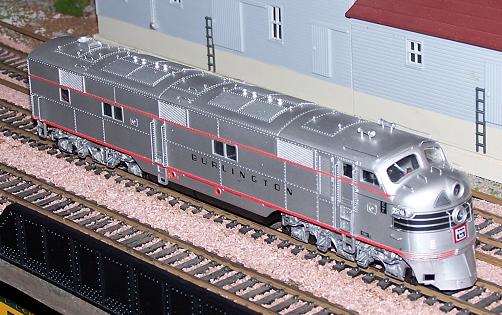
Here is a picture of the E7A number 9924A:


Here is a picture of the E8A number 9941B:


These models were very detailed right out of the box. The extra details that I have added so far make them stand out even more. Mostly what I did was add additional grab irons on the cab, nose and roof. There is a lot more that can still be done.

Information about proper placement of these details can be found in various publications and web sites. For instance, here is a link to a picture of the full size 9941B.

It is also interesting to notice how this railroad was inconsistent in its paint schemes. For instance, notice the difference in the color and number of stripes on the front of the locomotives.

Many of the Burlington E7’s and E8’s had their side frames replaced with stainless steel the entire length of the locomotive behind the cab. These two never had that done.

I am looking forward to completing my Empire Builder. Unfortunately, it wall take almost a year since the cars are being release about one per month.

Wednesday, August 30, 2006

Old Postings

If you are looking for my non-railroad topics, you can find them on my new blog.

The Denver Zephyr

The Denver Zephyr was the Burlington’s top Chicago to Denver train. It was the main competition to the C&NW / UP City of Denver. It’s overall schedule was almost identical in 1950 as shown below. It traveled the route at an average speed of 63 mph.
StationLeaveTotal MilesMilesMinutesAvg Speed
Chicago5:00 PM
Galesburg, IL7:07 PM16216212777
Burlington, IA7:51 PM206444460
Ottumwa, IA8:56 PM280746568
Creston, IA10:42 PM39311310664
Council Bluffs, IA12:08 AM492998669
Omaha, NE12:30 AM49642211
Lincoln, NE1:45 AM551557544
Hastings, NE3:23 AM648979859
Holdrege, NE4:12 AM702544966
McCook, NE5:32 AM779778256
Akron, CO6:40 AM92214312867
Fort Morgan, CO7:13 AM956343362
Denver, CO8:30 AM1034787761
Today, Amtrak’s California Zephyr is the only train to run between Chicago and Denver. Its schedule is shown below. It is a bit slower but not all that much – at least when it is on time. It travels the route at an average speed of 56 mph. Not all Amtrak stops are included. They stop at more places than the Denver Zephyr did. They also eliminated a couple of stops.
StationLeaveTotal MilesMilesMinutesAvg Speed
Chicago1:50 PM
Galesburg, IL4:28 PM16216215862
Burlington, IA5:15 PM206444756
Ottumwa, IA6:43 PM280748850
Creston, IA8:31 PM39311310863
Omaha, NE10:19 PM49610310857
Lincoln, NE12:18 AM5515511928
Hastings, NE1:57 AM648979959
Holdrege, NE2:44 AM702544769
McCook, NE3:53 AM779776967
Fort Morgan, CO5:15 AM95617713877
Denver, CO7:30 AM10347813535

Tuesday, August 29, 2006

C&NW Passenger Trains

Unfortunately, I think, a lot of the most interesting railroads have been merged out of existence into a handful of mega railroads. For instance, the current Union Pacific Railroad consists of the old original Union Pacific plus Chicago and North Western, Missouri Pacific, Missouri-Kansas-Texas, Western Pacific, Southern Pacific, and Denver and Rio Grande Western. These railroads include numerous other railroads as well.
My original and current favorite is the Chicago and North Western. It’s because I grew up near the C&NW mainline in the Chicago area and it has a rich history of passenger trains. I also worked for them for a couple of years in the early 1980’s.
The C&NW has a long history that goes back more than 150 years. When it was absorbed into Union Pacific in 1995, it was one of the oldest companies in the United States. How many companies can you think of that still exist that are over 150 years old an still operate with the same name as 150 years ago?
The C&NW line that went west out to Omaha, Nebraska was the host of many famous passenger trains that originated in Chicago including the “City” trains that were operated in conjunction with Union Pacific: City of Los Angeles, City of San Francisco, City of Portland, City of Denver. There were also trains like the Pacific Limited (Chicago to LA), San Francisco Challenger, San Francisco Overland Limited, Los Angeles Challenger, Los Angeles Overland Limited, The Columbine (to Denver), The Portland Rose, The Forty Niner (to San Francisco). They also had trains that went north and northwest to Wisconsin and Minnesota. Trains like The 400, The Viking, The Victory, and the North Western Limited. These were the "big" and famous trains on the C&NW. There were lots of other trains that had names and many that had only numbers.
Not a single one of these trains made it to the Amtrak era. And, I never saw a single one of the big named trains other than in pictures.
So I have a model of one of them using Walthers’ passenger cars and Proto 2000 E6, E7 and E8 locomotives.
In February of 1950, the westbound City of Denver, train 111, had the schedule shown below. The train was turned over to Union Pacific in Omaha. The train had an overall average speed of 64 mph for the 1048 mile run from Chicago to Denver. This was one of the faster Chicago to Denver trains in 1950.
StationLeave Total MilesMilesMinutesAvg Speed
Chicago5:00 PM
Sterling, IL6:37 PM1101109768
Clinton, IA7:04 PM138282762
Cedar Rapids, IA8:15 PM219817168
Marshalltown, IA9:18 PM289706367
Ames, IA9:51 PM327383369
Boone, IA10:10 PM340131941
Council Bluffs, IA12:17 AM48514512769
Omaha, NE12:30 AM48831314
Columbus, NE1:55 AM570828558
Grand Island, NE2:50 AM632625568
Kearney, NE3:28 AM674423866
North Platte, NE4:47 AM769957972
Julesburg, CO5:00 AM851827367
Sterling, CO5:55 AM908575562
La Salle, CO7:20 AM1001938566
Denver, CO8:30 AM1048477040

Sunday, August 27, 2006

Railfanning August 27, 2006

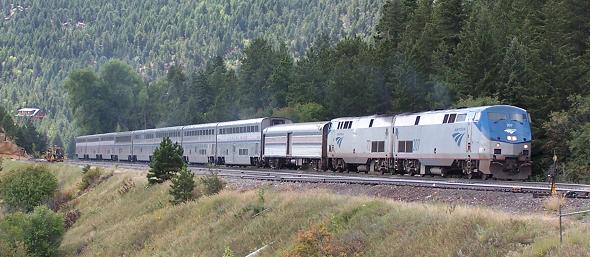
Spent a good part of today railfanning the Moffat subdivision of the Union Pacific. Here is a picture of Amtrak’s California Zephyr running at least 2 hours late. This photo was taken at Crescent, one of the sidings that the trains encounter on their way up to the Moffat Tunnel. The equipment on this train has seen better days. Some corrosion and flaking paint. I hope they are in better condition inside.


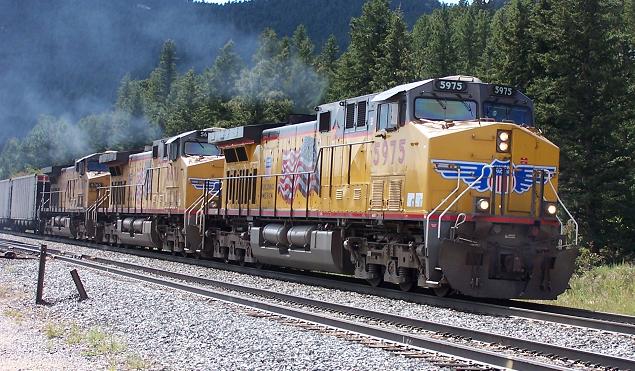
There were some nice freights up there too such as this coal train also at Crescent.


I saw several of these coal trains. Most were empties but one was loaded.

Up at the Moffat Tunnel, it was 50 degrees compared to 73 back down in Denver. I walked a little ways up the trail that begins here and ends up at Arapaho Lakes about 7 miles away. I just went around to the backside of the tunnel portal to see what I could see. While I was there, the tunnel’s ventilation fan was operating. It’s quite noisy and runs 20 minutes or so until the tunnel is ventilated. They do this after each train runs through in order to avoid breathing problems for the railroad personnel. The Moffat Tunnel is about 6 miles long and comes out at Winter Park on the other side of the Continental Divide. No train came through the tunnel while I was there.

I drove up the old Rollins Pass road about a half mile. The road is in as bad of shape as ever. Lots of pot holes and rocks. Nice view of the railroad leading to the tunnel though. This road was the railroad itself before the tunnel was completed in 1927. You can read my story of cycling up Rollins pass if you'd like.

Wednesday, August 23, 2006

Along the Joint Line 1

Here is a set of locomotives that are often seen south of Denver doing switching duties at various industries. It's an interesting set because the three are quite different looking with three different heritages. This photo was taken on August 23, 2006.


The Rio Grande engine is a GP40-2 with 3000 horsepower. It has been renumbered via a patch to Union Pacific 1348. It used to have Rio Grande number 3126 and was built in 1974.

The Cotton Belt engine has also been patched by Union Pacific to number 1526. This engine was originally built as a GP40 in 1967. It had a series of owners and numbers beginning with Louisville and Nashville 3024, then Seaboard 6820, then CSX 6820. Then Cotton Belt got it and numbered it 7291. It was rebuilt in 1991 into what the railroad calls a GP40-2M. It has 3000 horsepower.

The Union Pacific 1924 engine is a GP60 that was built in 1988 as Cotton Belt 9622. It used to look a lot like the Cotton Belt engine in the photo. It spent about a year as Union Pacific 5724 before getting the number shown here. GP60's have 3800 horsepower.

Tuesday, August 22, 2006

Where Were Those Trains Going?

I remember vividly right after going to bed hearing the sound of trains going through Lombard. Our house was about 4 blocks from the tracks where there were frequent trains. There was always a train going by when I was too far away to see what sort of train it was. They did not often blow their horns through Lombard and the other western suburbs. Lombard was a bedroom community and people were aware of the need to be cautious by these high speed tracks. But especially late at night, you could hear the trains anyway. It was the sound of the diesel locomotives and the sound of the train’s wheels hitting the joints in the still-jointed tracks. I could tell if it was just another commuter train heading out to West Chicago or Geneva or towards Chicago. The sound of the F7’s and E8’s were distinctive and recognizable because of the sound of their acceleration away from the Lombard station. Freight trains were different because they made a steady sound with little or no acceleration. They might have had their terminus as close as Proviso Yard about 10 miles east or they might have gone all the way into Chicago. They also could have gone to any number of far away points west but most often to Omaha where the train would be turned over to the Union Pacific to go even farther west – even as far as California.

Monday, August 21, 2006

Railroad Interest - Part 2

I grew up in Lombard, Illinois. Lombard had three railroads running through it at one time. The only one that still exists today is the Union Pacific line that runs between Chicago and Omaha and points farther west. This was part of the original transcontinental railroad and was known as the Chicago and North Western when I was growing up. It was absorbed into the Union Pacific in 1995.

Lombard also had a single track line usually know as the Great Western or, more formally, the Chicago Great Western. This line ran from Chicago out into Iowa and is now a bike trail through Lombard. It was merged into the Chicago and North Western in 1968 and gradually abandoned over the next decade or so.

There was an interurban railroad that ran through Lombard. The Chicago, Aurora and Elgin. We called it the "Roarin Elgin". This was an electric line that ran between its namesake cities. It ceased operating in 1957 and in the 60’s was converted into a trail called the Illinois Prairie Path. Great for hiking and biking.

All three of these lines were fascinating for me to poke around. I never saw a train on the CA&E but did see some on the CGW after it was merged into the C&NW. Trains on that line were rare. The C&NW, of course, had lots of trains including commuter trains and freight. I used to ride my bicycle up along the C&NW after school to watch a train or two and the first of the evening rush hour commuter trains. I liked the Elizabeth Street crossing because you could see the farthest at this point where the track curved slightly. From here you could see well past Grace Street to the east and a good ways into Glen Ellyn to the west.

The Prairie Path was fun to ride my bicycle on as well since over in the next two suburbs west, Glen Ellyn and Wheaton, it was adjacent to the C&NW tracks. So I could ride over there and see some trains on the C&NW as well.

I used to notice railroad artifacts along these lines. One of the interesting items on the CA&E is the remains of an old station in Glen Ellyn just east of Hill Avenue. As of about 2003, it was still there. It was much more overgrown that it was 20 years earlier. It consists of some brickwork that must have formed an arch over the entry to the station. That’s it. You could also find the remains of station platforms at various places through Lombard.

One of the unusual things about the C&NW line is the lack of lighted signals. Instead, they have signals in the cabs of the locomotives which receive their indications through low voltage current in the track. But it wasn’t always this way. Over in Elmhurst, you can see signal bridges still in place. Years ago, I noticed concrete supports along the right of way just west of Lombard. These had to be for signals that were there at one time, long ago.

The C&NW track through Lombard is where I found some date nails. These were nails with the number 57 on top representing 1957. The pole line on the south side of the tracks was put up by Western Union. The poles had date nails in them as well - 42 for 1942.

Sunday, August 20, 2006

My Interest in Railroads - Part 1

I have long been interested in many aspects of railroads and railroading. What is it that I like about them and why? The origins of my interest in railroads goes back to when I was a kid. It must have been about 1964 or so when I was about 7 years old when I got a Lionel trainset for Christmas. It ran in a figure 8 with a single steam locomotive and a set of freight cars. I still have one of the cars – a Sunoco tank car. I don’t know the origin of this trainset but I believe the set was used since the cars were not particularly pristine or even fully functional. I liked it anyway.

A few years later, I found a report that my brother had done for school about railroads. I found this fascinating because everything my older brother did was fascinating by definition. I had to do a lot of things that he did and I was interested in many of the things that he was interested in because, well, he was cool – simple as that. He was (and still is) 12 years older than me. To prepare this report, he acquired numerous booklets and other information directly from the railroads. So, I had to do that as well. I wrote to the railroads, and there were lots of them back then, and asked them for whatever information they could send me. They sent some of the same booklets published by the Association of American Railroads as well as timetables, photographs, and posters - all for free. I still have a lot of this material that dates back to the late 60's.

These are some of the things that sparked my interest in railroads.

Tuesday, August 15, 2006

Mischief Along the Railroad

My interest in railroads began sometime in the 60’s. Where that interest comes from will be the subject of another posting. Sometime in about 1970 when I was 13, there were three of us (Randy, Leif and I) who rode our bikes up to the Chicago and North Western triple track mainline in Lombard, Illinois – about 5 or 6 blocks from where we lived. It was late in the day during the week so there were numerous lengthy commuter trains bringing workers home from Chicago to the suburbs. This did not deter us from walking right down the tracks while leaving our bikes at the station.

After walking about a quarter of a mile, one of us found a fusee - a railroad flare - lying on the ballast along one of the three tracks. Why it was there, we didn’t know. What it was for, we didn’t know. It had never been used.

Well, it hadn't been used until we lit the thing. Now, these things burn very hot and we found an empty soda can nearby and found that it could burn a hole in it quite easily. It was entertaining for a while but we left it behind to finish burning while we continued walking on down the tracks.

A little while later, here comes a man walking down the tracks towards us. When he gets close to us, he whips out his badge and identifies himself as a policeman with the C&NW police department. He said that he drove all the way from Chicago to find out what we were up to. He explained to us what fusees were for – emergencies that require trains to stop when sighted. He took our names down and gave us some well deserved scolding about the dangers of hanging out on railroad tracks – especially ones where trains go as fast as they sometimes did in Lombard. He also cautioned us about putting stuff on the tracks saying that even a penny can cause problems. He then told us that if we wanted to watch trains, which is what we were really interested in doing, that we should do it from the station platform or off railroad property. He realized that we were just kids who did not realize the meaning of the fusee and let us go on own way. He did tell us that he didn’t want to see our names come across his desk again.

Not feeling particularly guilty about all of this, we went back to the station and waited for another train or two. The train that went all the way to Clinton, Iowa on the center track came through a lot slower than usual that evening.

Then we went home and that is when we found out that the railroad cop had called our parents.

In 1980, when I actually went to work for the same railroad, the subject did not come up.

Tuesday, August 08, 2006

Acequia, Colorado

An acequia is a community operated waterway used in the American Southwest for irrigation. Acequias are usually historically engineered canals that carry snow runoff or river water to distant fields.

There is a location along the nearby railroad joint line that is called Acequia. It is just southwest of Highlands Ranch, Colorado. At one time on both railroad lines, there were sidings at this location. I have heard railroad personnel refer to this location occasionally as Acequia. Here is the location on a topographic map. Acequia is clarly marked and you can see both railroad lines on the map. If you zoom in enough, you can see that both railroads had sidings. The western track, currently owned by Union Pacific, was originally built by the Denver and Rio Grande Western. The eastern track, currently owned by Burlington Northern and Santa Fe, was originally built by a subsidiary of the Atchison, Topeka and Santa Fe Railway.

Also on the map, you can see that near Acequia, the Highline Canal runs between the two tracks and then turns to the west and the one track goes over the canal. Railroads often named places after some geographical feature. In this case the canal. The canal was built through here about 1880. The Rio Grande track was built in 1871. The other track, built by a subsidiary of the Santa Fe Railway was built in 1887.

I rode my bike to near this location this evening. It's a ride of about 5 miles from home if I go the long way. I followed the Highline Canal trail all the way to a place where the canal trail is no longer rideable because of the presence of evil weeds that contain a plethora of "goat heads" (which I will write about in another posting). About 1/4 mile south of where I stopped is the actual location of Acequia. Then a little ways farther south, the canal turns under the track as stated above and then it heads through a tunnel under a ridge and under Plum Creek. That’s why the trail is really broken at this point. See this satellite photo.

One of the cool things about the ride tonight was the presence of three large full-racked elk that were hanging around. They were quite wary of me being there and moved off into the nearby woods as I rode by. I was never closer than about 150 yards.